← All Species
Stenella frontalis
Atlantic Spotted Dolphin
Least Concern
Also known as: Spotter +1 more
Stenella frontalis
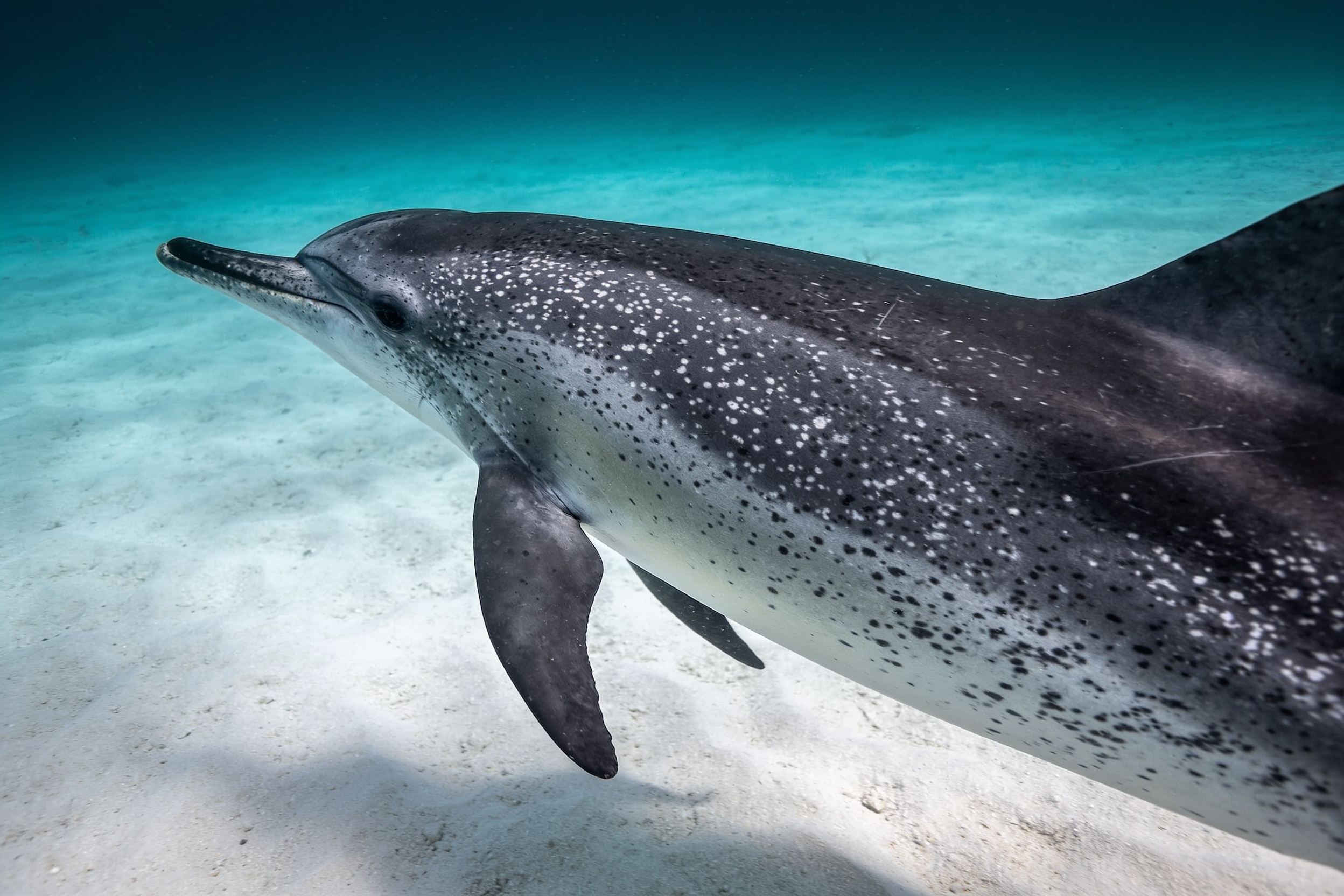
Like the Pantropical Spotted Dolphin, Atlantic Spotted Dolphins are born without spots. Calves are uniformly grey; spots develop gradually — first on the belly, then spreading to the entire body. Old adults may be so heavily spotted that the dark and light areas merge, creating an almost entirely grey appearance. Distinguished from the Pantropical Spotted by a stockier build and broader beak.
Well-developed echolocation and hearing. Good vision in clear Atlantic waters. Studies in the Bahamas have shown Atlantic Spotted Dolphins use complex vocalizations and can recognize specific individuals by their signature whistles.
Atlantic Spotted Dolphins produce complex whistles and click-burst vocalizations. Long-term research in the Bahamas has documented consistent signature whistle use over decades, with individual dolphins recognized by researchers for their entire adult lives.
Hunts cooperatively for fish and invertebrates. In the Bahamas, a key foraging technique involves rooting through sandy seafloor sediment with the beak to flush buried prey — particularly garden eels and goatfish.
Gestation
11 months. Females give birth every 3 years.
Birth
Calves are born at approximately 35 inches and 25 lbs, without spots.
Calves
Calves nurse for 3–5 years — one of the longest nursing periods documented in wild dolphins. Young calves develop spots progressively, allowing age estimation by spot density.
Females reach sexual maturity at approximately 8–15 years; males at 12–15 years.
Found in groups of 5–15 for daily activities; larger aggregations of 50+ form during feeding. Long-term individual relationships are well-documented. The Bahamas population has been studied by Wild Dolphin Project researchers for over 35 years, producing the most detailed behavioral dataset of any wild dolphin population.
Fast and acrobatic. Regularly leaps, bow-rides, and somersaults. Often approaches vessels to play in the pressure waves. Can swim at 17+ mph.
The Bahamas population of Atlantic Spotted Dolphins is one of the most intensively studied wild animal populations in the world — with individual dolphins tracked for their entire lives, revealing complex social networks, family relationships, and cultural behaviors.
50+ years. Threats include bycatch in pelagic longlines and drift nets, prey depletion, marine pollution, and disturbance from whale-watching and swim-with-dolphin tourism operations.
Dolphin Store