← All Species
Pseudorca crassidens
False Killer Whale
Near Threatened
Also known as: Pseudorca +1 more
Pseudorca crassidens
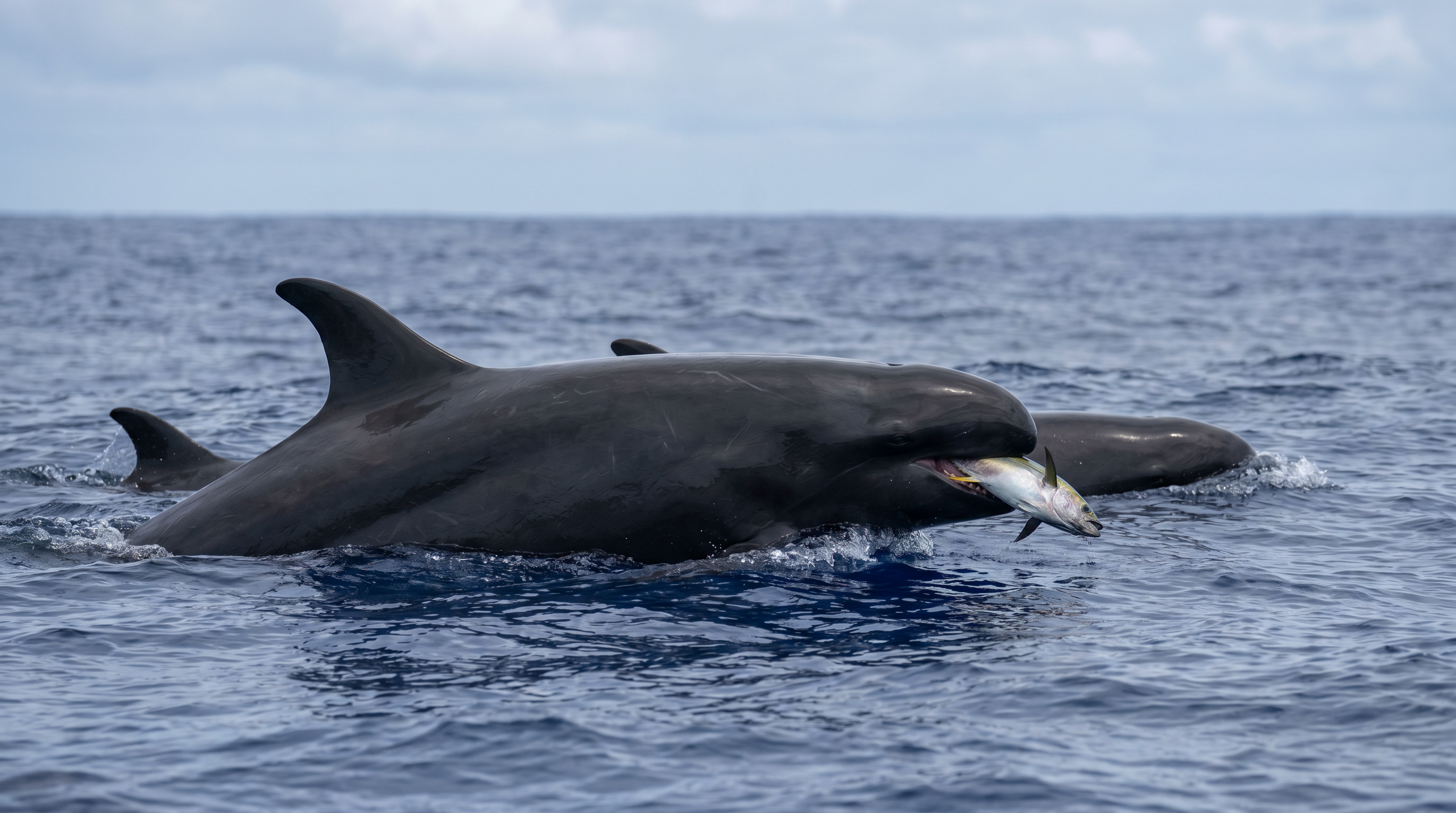
The False Killer Whale is named for its superficial resemblance to the Orca — both are dark, large, and robust. But the False Killer Whale is slimmer, with a more rounded head and no distinctive white eye patch. One of the most socially complex delphinid species, it is known for forming long-lasting bonds, sharing food with pod members, and occasionally with humans.
Exceptional echolocation and hearing for deep-water prey location. Vision is adapted for detecting large, fast prey species at depth. Highly perceptive of human presence — known to approach divers deliberately.
Produces complex clicks, whistles, and pulsed calls. False Killer Whales maintain strong social bonds through vocalizations. Hawaiian populations have stable social groups with vocal signatures that may constitute group-specific dialects.
High-speed pursuit predator — one of the fastest large delphinids, reaching 18 mph. Targets large, fast fish including tuna, mahi-mahi, and wahoo. Frequently robs longlines. Known to hunt cooperatively and share large prey items with pod members — food sharing behavior unusual among dolphins.
Gestation
15 months. Females give birth every 6–7 years — one of the lowest reproductive rates of any dolphin. Females also undergo menopause.
Birth
Calves are approximately 5–6 feet long and 175 lbs at birth — proportionally large.
Calves
Calves nurse for 18–24 months. Family bonds are very strong — pod members collectively care for calves.
Females reach sexual maturity at approximately 8–11 years; males at 10–14 years. Females stop reproducing at around 45 years and may live decades beyond.
Found in stable pods of 10–50 individuals. Hawaiian populations have well-documented long-term social bonds between specific individuals across years. Social structure appears matrilineal, similar to orcas.
One of the fastest large dolphins — reaching 18+ mph. Frequently leaps completely out of the water. Known to approach vessels and interact with swimmers in a playful manner.
False Killer Whales are one of the few dolphin species documented to share food with humans — offering fish to divers in open water, a behavior not yet fully explained by researchers. They also hybridize naturally with Bottlenose Dolphins; the hybrid offspring (called "Wholphins") have been documented in the wild off Hawaii.
60+ years for females; 55+ for males. Primary threats include longline bycatch (the main-Hawaiian Islands population is critically endangered with fewer than 170 individuals), directed hunting, prey depletion, and pollutant bioaccumulation.
Dolphin Store