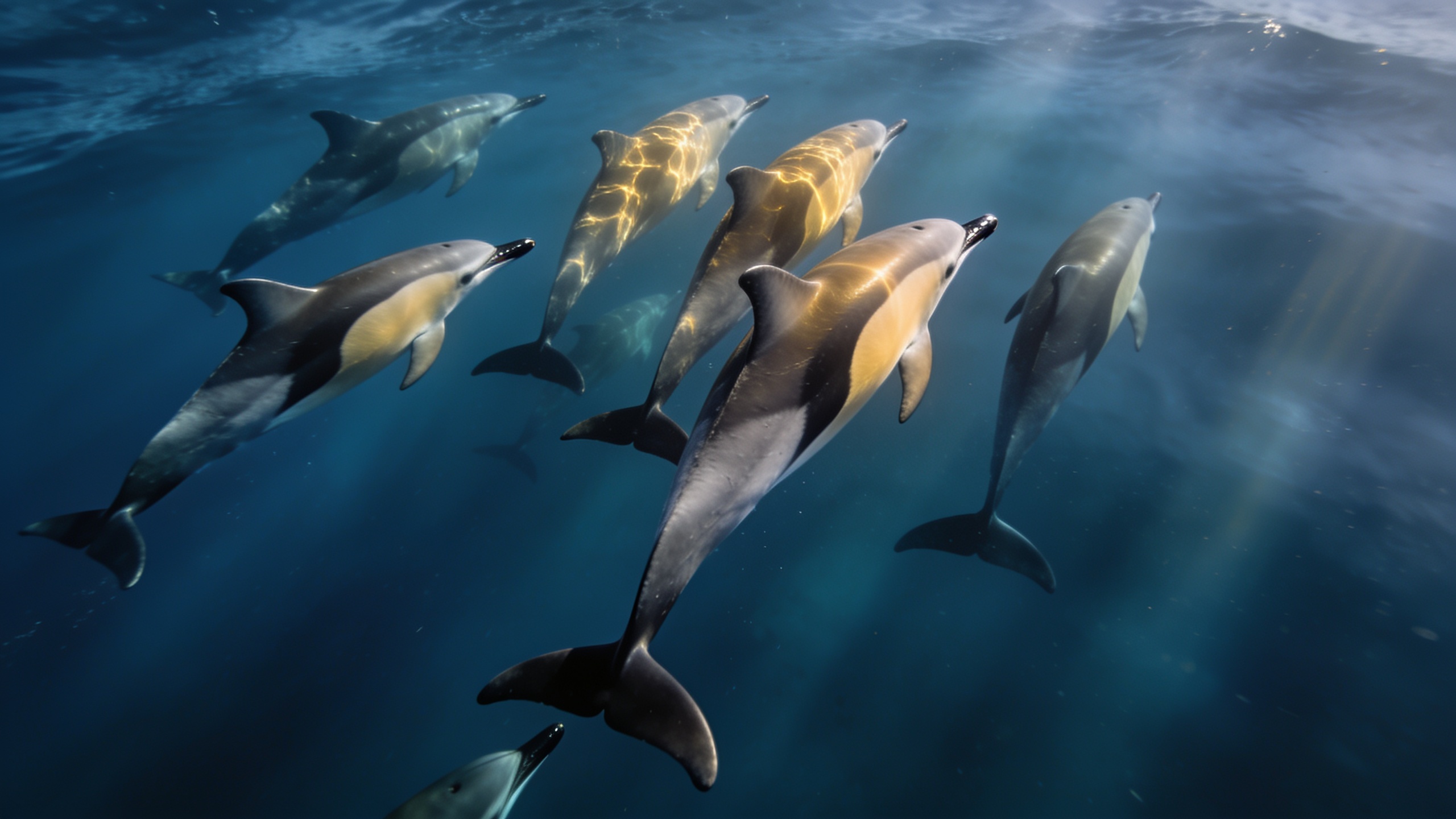
A stocky, robust dolphin with a short, thick beak — the shortest of any member of the family Delphinidae. Coloring: blue-grey to brownish-grey back, a distinctive dark lateral stripe running from the eye to the anus, cream-to-pink sides, and a white belly. First described from a skull in 1956; not confirmed alive until 1971.
Fraser's Dolphins have well-developed echolocation and hearing suited to the deep open ocean.
Fraser's Dolphins produce high-frequency clicks and whistles. Very little is known about their social communication given the rarity of observation.
Deep divers — feeding at depths of 800+ feet on mesopelagic fish, squid, and crustaceans.
Gestation
Approximately 11–12 months. Reproductive rate estimated every 1–3 years.
Birth
Calves are estimated at approximately 40 inches long and 40 lbs at birth.
Calves
Very little is known about calf behavior in this species. Nursing is estimated at 12–18 months based on comparison with similar species.
Estimated at 5–8 years for both sexes.
Fraser's Dolphins travel in large, tightly packed groups of 100–1,000 individuals. Groups often mix with Melon-headed Whales, Striped Dolphins, and Spinner Dolphins.
Active swimmers capable of rapid sprints, occasionally seen bow-riding.
Fraser's Dolphin was described from a skull collected in Sarawak in 1956. The species was simultaneously stranded in three different countries in 1971.
18+ years. Threats include deep-water fisheries bycatch, marine pollution, and ingestion of plastic debris.
Dolphin Store