← All Species
Cephalorhynchus heavisidii
Heaviside's Dolphin
Near Threatened
Also known as: Haviside's Dolphin +1 more
Cephalorhynchus heavisidii
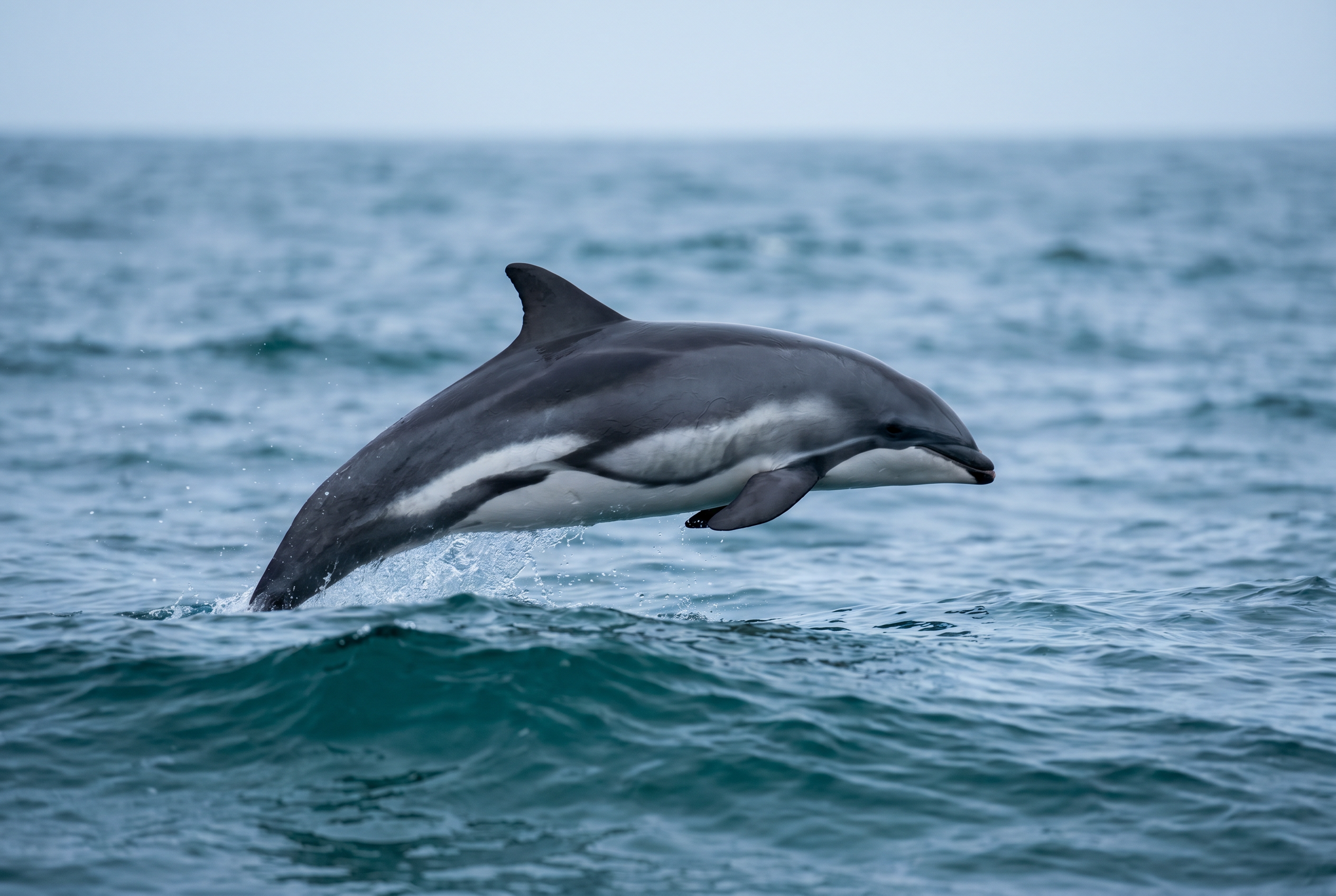
One of the four Cephalorhynchus species and one of the most boldly patterned small dolphins. Heaviside's Dolphins have a dark blue-grey back and head, white belly, and a complex dark and white flank pattern. The dorsal fin is small and triangular — more pointed than the round fin of Hector's or Commerson's Dolphins. Found only in the waters of Namibia and South Africa.
Uses narrow-band high-frequency echolocation — the same as porpoises and other Cephalorhynchus species. This type of echolocation is difficult for orcas to detect, possibly providing a predator avoidance advantage.
Like other Cephalorhynchus species, Heaviside's Dolphins produce only high-frequency clicks — no whistles. This limits long-range communication but reduces detection by predators.
Feeds in the productive Benguela Current upwelling system on schooling fish (mullet, anchovy), squid, and octopus. Often forages in shallow surf zone and kelp beds.
Gestation
Approximately 10–11 months. Females give birth every 2–3 years.
Birth
Calves are approximately 24 inches long and 10 lbs at birth.
Calves
Calves remain with their mothers for 1–2 years.
Estimated at 5–9 years for both sexes.
Found in small groups of 2–10 individuals. Larger aggregations of up to 30 occasionally form at productive feeding sites. May associate with Dusky Dolphins at the southern end of their range.
Energetic and acrobatic for their size. Heaviside's Dolphins are known for spectacular aerial displays — including spinning leaps more like a Spinner Dolphin than most Cephalorhynchus species. Actively bow-ride vessels.
Heaviside's Dolphin was named for a Captain Heaviside (sometimes written Haviside) who collected specimens in the early 19th century, though for many years the species was mistakenly believed to be named for mathematician Oliver Heaviside. The confusion over the name persists in some literature today.
Estimated 15–20 years. Threats include gillnet bycatch in South African and Namibian fisheries, direct hunting, boat disturbance, and climate-driven changes in the Benguela Current upwelling system.
Dolphin Store