← All Species
Lagenorhynchus cruciger
Hourglass Dolphin
Least Concern
Also known as: Wilson's Dolphin +1 more
Lagenorhynchus cruciger
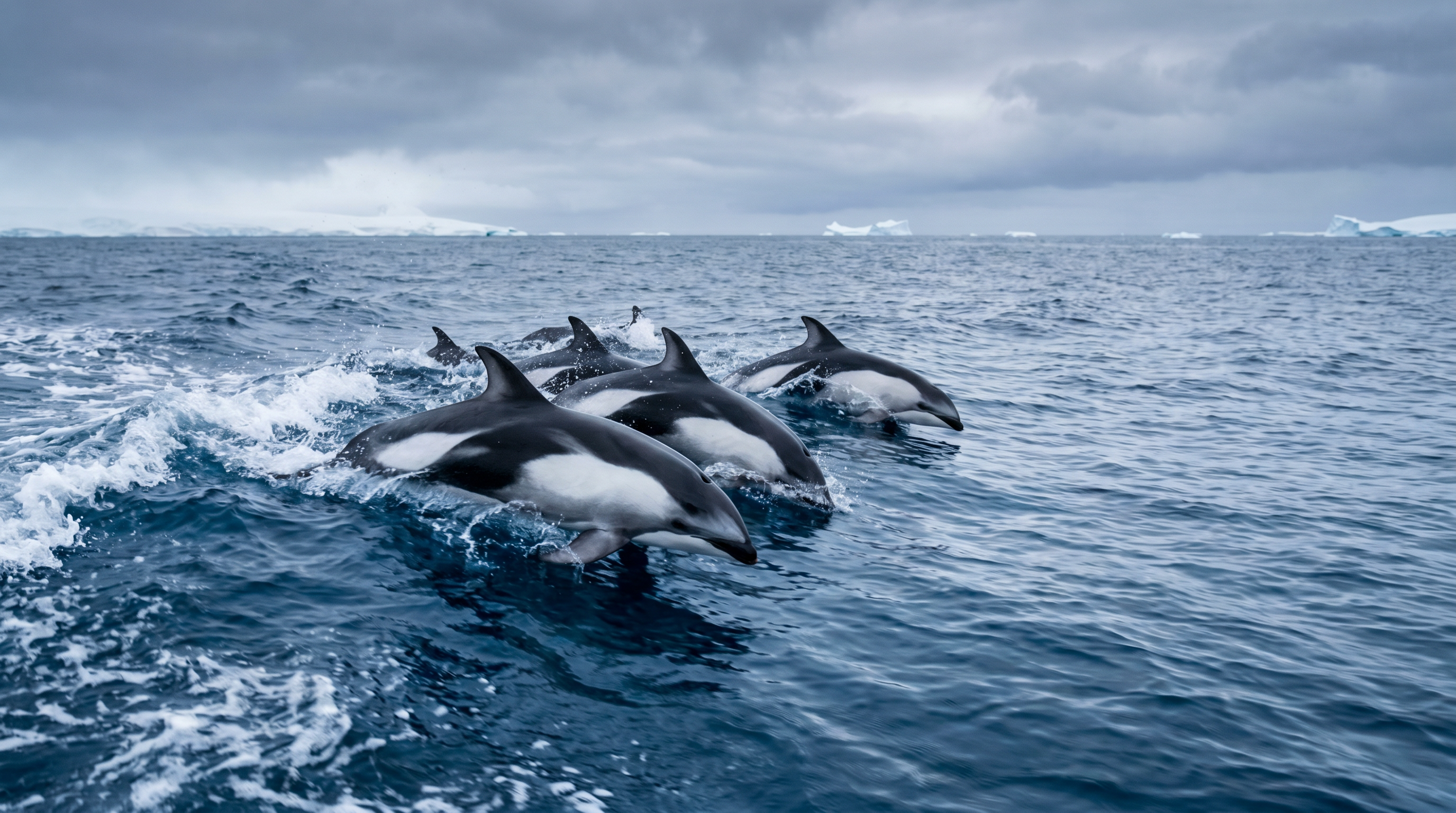
The Hourglass Dolphin is instantly recognizable by its bold black-and-white pattern: a dark back and flanks, with two distinct white patches connected by a narrow white stripe — creating an hourglass shape when viewed from the side. It is one of the least-studied dolphin species, inhabiting some of the most remote and inhospitable ocean in the world.
Well-developed echolocation and hearing suited to deep, cold Southern Ocean conditions. Vision is adapted to high-latitude conditions including extended periods of daylight and darkness.
Very little is known about Hourglass Dolphin communication due to the extreme remoteness of their habitat. They produce clicks and whistles and are observed communicating during bow-riding and social interactions around vessels.
Feeds on fish, squid, and crustaceans in the productive waters of the Antarctic Convergence. Presumably hunts cooperatively given their tendency to travel in cohesive groups.
Gestation
Estimated at 12 months by comparison with related species. Reproductive rate largely unknown.
Birth
Very few births have been directly observed. Estimated calf length 25–30 inches at birth.
Calves
Nursing duration and calf behavior largely unknown — very few observations exist.
Unknown. Estimated 7–10 years based on related species.
Found in groups of 1–100, most commonly 5–10 individuals. Frequently observed bow-riding vessels crossing the Southern Ocean — one of the few opportunities for direct observation of this species.
Active and fast swimmers in cold Southern Ocean waters. Enthusiastic bow-riders — often the only source of data on this species comes from researchers on ships crossing the Drake Passage.
The Hourglass Dolphin is one of the only cetaceans confirmed to regularly associate with Antarctic pack ice. It is so rarely seen that the total global population is estimated from only a handful of scientific surveys — less is known about this species than almost any other dolphin.
Unknown. Threats are poorly understood due to remoteness of habitat, but likely include prey depletion from Southern Ocean fisheries, climate-driven shifts in the Antarctic Convergence, and marine debris.
Dolphin Store