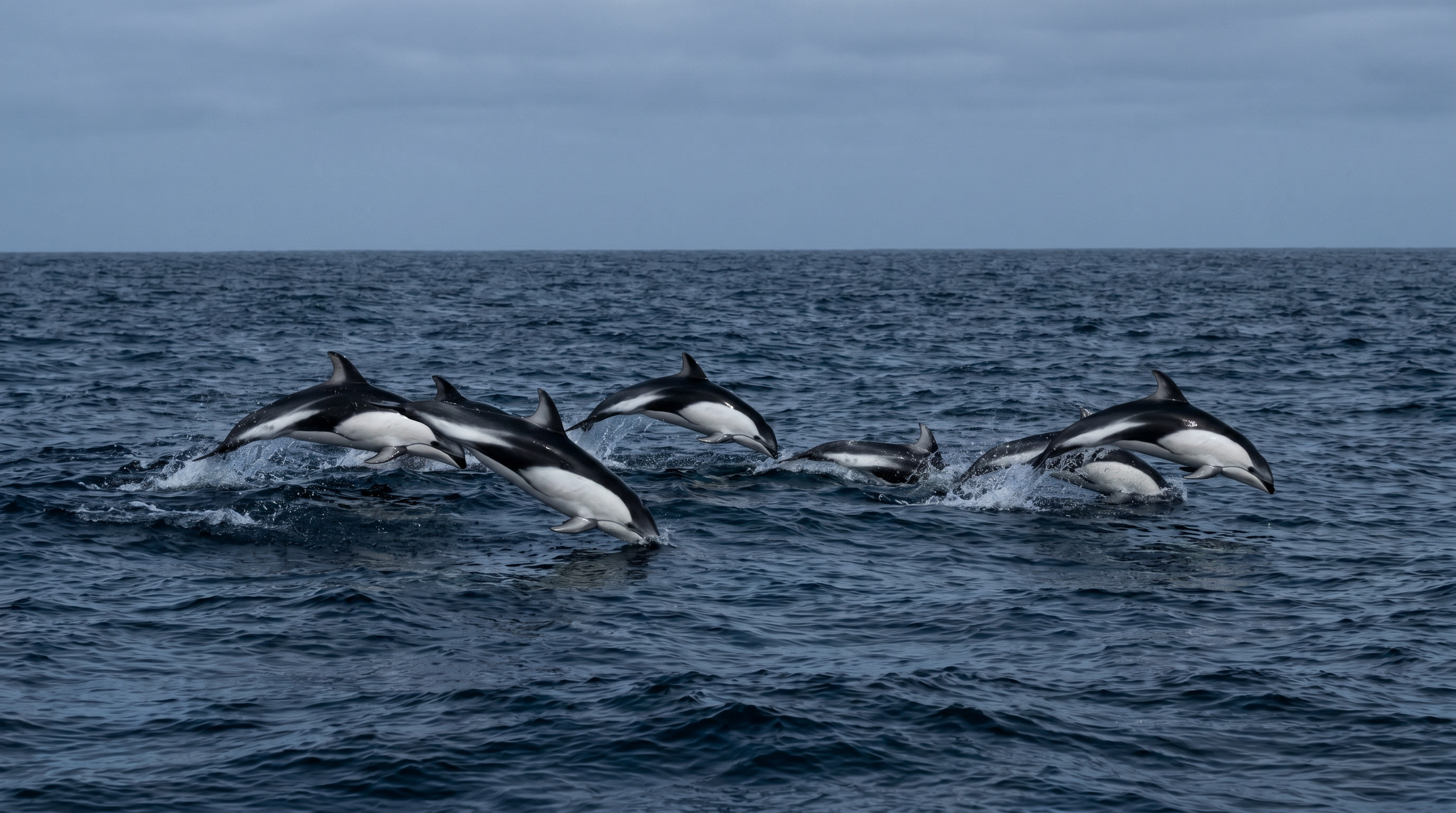
The Southern counterpart to the Northern Right Whale Dolphin — both are completely finless, giving them an elegantly streamlined torpedo silhouette. The Southern species has a more striking black-and-white pattern: completely jet black on the upper body, brilliant white on the belly and the entire undersides of the flippers, with a distinctive white beak tip. More boldly patterned than its northern counterpart.
Well-developed echolocation and hearing for deep-ocean hunting. Adapted to Southern Ocean conditions including low light levels in subpolar waters.
Very little is known about Southern Right Whale Dolphin communication. They produce clicks and whistles and communicate through body posture and synchronized swimming within large pods.
Deep divers feeding primarily on squid and mesopelagic fish. Hunting strategies are poorly known due to the remote nature of their habitat. Frequently associated with Long-finned Pilot Whales and Dusky Dolphins at productive Southern Ocean feeding sites.
Gestation
Estimated at 12 months based on related species.
Birth
Estimated calf size 25–30 inches at birth. Very few births have been directly observed.
Calves
Nursing duration and calf behavior largely unknown.
Unknown. Estimated 10+ years based on comparison with northern counterpart.
Found in groups of 5–1,000+. Often travels in large mixed-species groups with Dusky Dolphins, Hourglass Dolphins, and Long-finned Pilot Whales. Enthusiastic bow-riders — one of the primary opportunities for observation in remote Southern Ocean waters.
Fast and elegant swimmers — porpoising in long, graceful arcs. Can reach 25 mph in short bursts. Actively seeks out vessel bow waves for extended rides.
The Southern Right Whale Dolphin and the Northern Right Whale Dolphin are the only two completely finless dolphin species in the world. Their shared adaptation — losing the dorsal fin entirely — convergently evolved in two distinct hemispheres, making them a fascinating example of parallel evolution.
Unknown. Threats include bycatch in drift nets and longlines, prey depletion from Southern Ocean fisheries, and climate-driven changes in Southern Ocean productivity.
Dolphin Store